
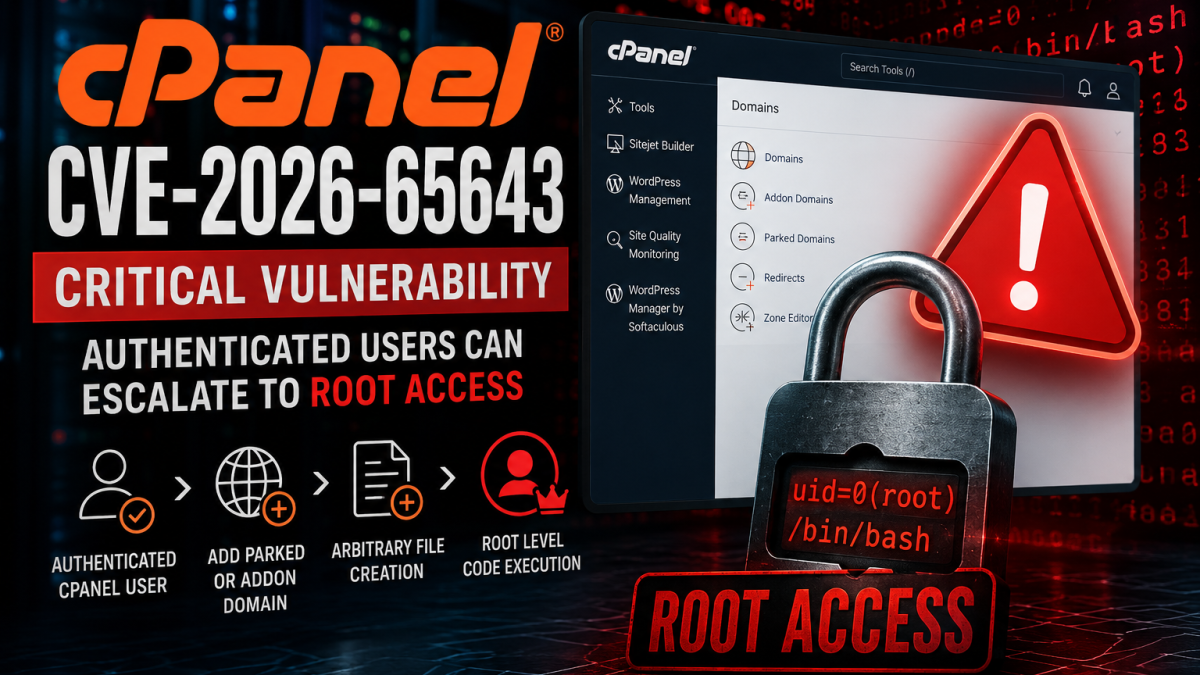
A newly disclosed cPanel vulnerability could allow an authenticated hosting user to escalate their privileges all the way to root, potentially putting every website, database, and hosting account on the affected server at risk.
cPanel disclosed CVE-2026-65643 on August 27, 2026, and released security updates for affected cPanel & WHM versions.
The vulnerability affects cPanel’s parked and addon domain functionality. According to cPanel, an authenticated user who has permission to add parked or addon domains may be able to abuse the flaw to create arbitrary files on the underlying server.
The most serious part is what can happen next.
Successful exploitation can ultimately lead to code execution as the root user.
On a shared hosting server, that turns a vulnerability available to an ordinary customer account into a potential server-wide compromise.
For hosting providers and anyone operating cPanel infrastructure, this is a patch-now issue.
What Is CVE-2026-65643?
CVE-2026-65643 affects the part of cPanel responsible for managing parked domains and addon domains.
Both are common features on shared hosting accounts.
An addon domain allows a customer to host another domain within the same cPanel account. A parked domain, now more commonly called an alias, points an additional domain to an existing website.
Normally, a customer using these features should only be able to affect resources belonging to their own account.
CVE-2026-65643 breaks that boundary.
According to cPanel, exploitation requires:
- An authenticated cPanel account
- Permission to add parked or addon domains
- Access to the vulnerable functionality
If those conditions are met, the vulnerability can allow arbitrary files to be created on the server.
From there, successful exploitation can result in root-level code execution.
That makes the flaw particularly dangerous on multi-user hosting servers. A compromised customer account could potentially become the starting point for taking control of the entire machine.
Why Root Access Makes This So Serious
Shared hosting relies heavily on account isolation.
A normal cPanel user may have access to their own website files, databases, email accounts, cron jobs, domains, and application settings, but they should not be able to access another customer’s files or modify privileged system resources.
Root is different.
The root user effectively has unrestricted administrative access to the server.
If an attacker manages to exploit CVE-2026-65643 and execute code as root, the potential impact could include:
- Reading files belonging to other customers
- Accessing WordPress configuration files and database credentials
- Modifying or deleting websites
- Accessing databases hosted on the server
- Installing persistent malware or backdoors
- Creating additional privileged access
- Modifying system services
- Stealing sensitive information from multiple hosting accounts
The risk is especially significant on shared hosting infrastructure, where a single server may host hundreds or even thousands of websites.
The attacker does not need to start with WHM or root credentials. An ordinary authenticated cPanel account with the required domain-management permissions may be enough.
Which cPanel Versions Are Vulnerable?
cPanel says that all supported versions were affected and has released fixed builds across multiple release branches.
Administrators should be running at least the following versions:
| Product / Branch | Patched Version |
|---|---|
| cPanel & WHM 110 | 11.110.0.141 or later |
| cPanel & WHM 134 | 11.134.0.53 or later |
| cPanel & WHM 136 | 11.136.0.37 or later |
| cPanel & WHM 138 | 11.138.0.2 or later |
| WP2 | 11.138.1.7 or later |
These fixed versions were published as part of cPanel’s August 27 security advisory.
If your server is running an earlier build within one of these branches, it should be updated.
If you are using an older release branch that is not listed, do not assume that it is unaffected simply because it does not appear in the table. Move to a currently supported cPanel version or confirm the correct upgrade path with cPanel.
How to Check Your cPanel Version
Administrators with shell access can check the installed cPanel & WHM version with:
sudo /usr/local/cpanel/cpanel -VThe current version is also displayed inside WHM.
Compare the installed build with the patched versions above.
For example:
11.138.0.1would still require an update.
A server running:
11.138.0.2meets the minimum patched version published for the 138 branch.
How to Patch CVE-2026-65643
The proper fix is simple: update cPanel & WHM.
From WHM, administrators can go to:
WHM → Home → cPanel → Upgrade to Latest Version
You can also update cPanel from the command line using the official upcp script:
sudo /usr/local/cpanel/scripts/upcpTo force an immediate update:
sudo /usr/local/cpanel/scripts/upcp --forceOnce the update finishes, verify the installed version again:
sudo /usr/local/cpanel/cpanel -VMake sure the result meets or exceeds the patched build for your release branch.
Don’t Assume Automatic Updates Already Protected You
cPanel normally includes mechanisms for automatically installing security updates.
According to cPanel’s current documentation, available security updates for the installed major version are checked and applied through an hourly security-update process by default.
That does not mean every server is guaranteed to be patched.
Automatic updates may not behave as expected if, for example, the update repository has been disabled or the server has been pinned to a specific version.
For a vulnerability that can potentially lead to root access, manually verifying the installed build is worth the few seconds it takes.
Run:
sudo /usr/local/cpanel/cpanel -Vand check the result directly.
Is There a Workaround?
At the time of writing, cPanel’s public advisory does not provide an official workaround that can be used instead of installing the patched release.
The advisory also does not contain enough technical detail about the underlying vulnerability to justify relying on unofficial filesystem changes or configuration tweaks.
Because exploitation requires an account with permission to add parked or addon domains, temporarily restricting that functionality could reduce exposure while an administrator prepares the update.
That should only be considered a temporary risk-reduction measure.
Installing the official cPanel security update is the correct fix.
Has CVE-2026-65643 Been Exploited in the Wild?
As of the publication of this article, there is no confirmed public evidence that CVE-2026-65643 is being actively exploited in the wild.
cPanel has not announced known exploitation, and early reporting following the disclosure did not identify a verified public proof-of-concept exploit.
That is not a good reason to postpone patching.
The vulnerability is now public, the affected functionality is known, and the potential payoff for an attacker is significant: root access to a hosting server.
Once a vulnerability becomes public, researchers and attackers can begin comparing patched and unpatched versions to work out exactly what changed.
Some Technical Details Are Still Missing
One interesting aspect of CVE-2026-65643 is how little technical information was available immediately after disclosure.
As of August 30, 2026, the official CVE record still lists CVE-2026-65643 as reserved, rather than publishing the more detailed metadata normally associated with a completed CVE entry.
There is also no official CVSS score yet.
cPanel’s advisory confirms that exploitation can move from arbitrary file creation to root code execution, but it does not explain the exact mechanism that connects the two.
That distinction matters.
Claims about a specific path-traversal bug, symlink technique, configuration injection method, or similar exploitation chain should therefore be treated cautiously unless cPanel or a credible security researcher publishes technical evidence supporting them.
What has been confirmed is already serious enough:
Authenticated cPanel account
        ↓
Arbitrary file creation
        ↓
Root code execution
An official CVSS score is not necessary to understand the risk created by that attack path.
Shared Hosting Providers Face the Greatest Risk
CVE-2026-65643 is particularly concerning because it attacks one of the fundamental security boundaries in shared hosting: the separation between customers.
Imagine a server containing 500 hosting accounts.
Normally, if one customer’s WordPress installation is compromised or their cPanel credentials are stolen, the damage should primarily remain within that customer’s account.
Privilege escalation changes the situation completely.
A compromised hosting account could potentially become a path to:
One customer account
        ↓
cPanel domain management
        ↓
CVE-2026-65643
        ↓
Root execution
        ↓
Entire server
That makes this vulnerability relevant not only to large hosting companies, but also to resellers, agencies, VPS owners, sysadmins, and organizations running their own cPanel infrastructure.
What Hosting Customers Should Do
Ordinary shared hosting customers usually cannot install the cPanel security patch themselves because the control panel software is managed by the hosting provider.
If you are concerned about CVE-2026-65643, ask your provider whether the server has been updated to one of the fixed builds released on August 27.
Customers should also continue following normal hosting-account security practices:
- Use a unique cPanel password
- Enable two-factor authentication where available
- Avoid sharing the primary hosting account
- Remove unnecessary FTP, SSH, and administrative users
- Keep WordPress and other applications updated
- Investigate unexpected login notifications
These steps do not patch CVE-2026-65643.
They do, however, reduce the likelihood of an attacker obtaining the authenticated hosting account required to begin exploiting the vulnerability.
Administrators Should Patch Now
CVE-2026-65643 is a good example of why vulnerabilities in hosting control panels deserve immediate attention.
The starting privilege is relatively limited: an ordinary hosting account with permission to manage domains.
The potential final privilege is the highest available on the system: root.
That turns what initially sounds like a vulnerability involving “domain parking” into a potentially server-wide security problem.
If you operate cPanel & WHM infrastructure, check your installed version now:
sudo /usr/local/cpanel/cpanel -VIf it does not meet the minimum patched build for your branch, update cPanel:
sudo /usr/local/cpanel/scripts/upcp --forceThe patch has been available since August 27, 2026.
When a vulnerability can potentially turn access to a single hosting account into full control of the server, it is not something worth leaving until the next routine maintenance window.43 is not an update worth leaving for the next routine maintenance window.