
Google just released Gemini 3.8 Flash. If the name sounds familiar, that’s because it’s the third Flash model they’ve launched in only six weeks. This rapid pace shows how quickly the AI race is moving, not just what the model can do.
What’s Actually New in Gemini 3.8 Flash
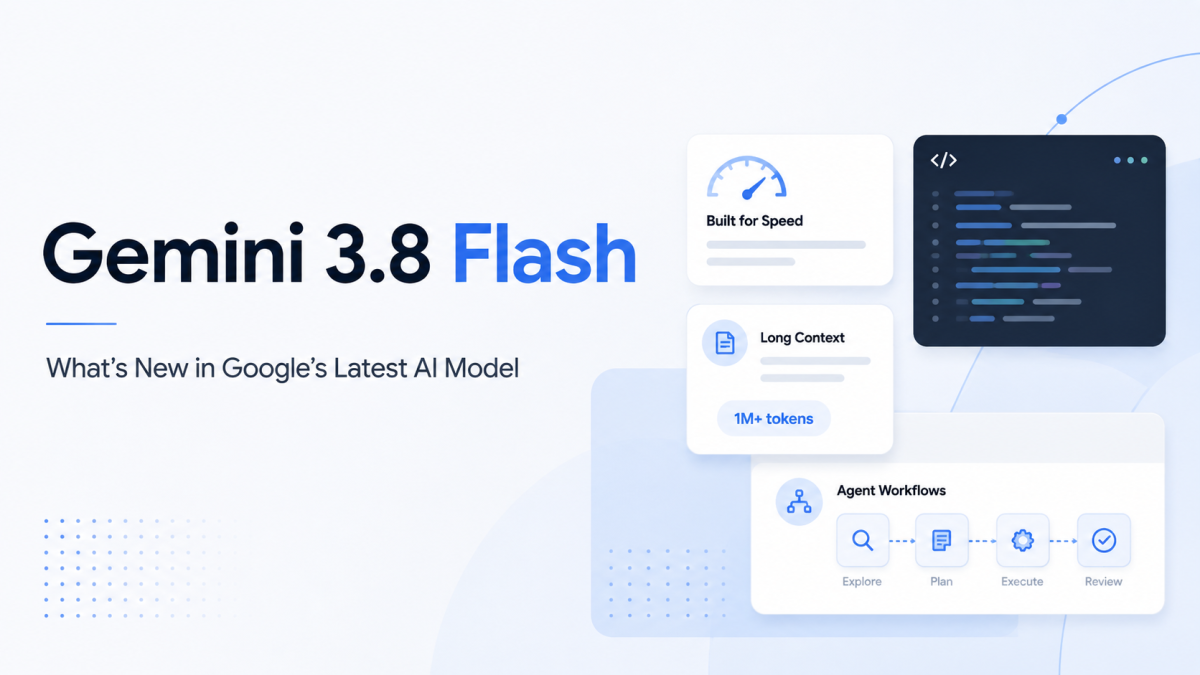
Gemini 3.8 Flash is Google’s reliable model: it’s fast, affordable, and now better at coding and multi-step reasoning than 3.7 Flash. Google says the main improvement is that the model puts in more effort. For complex tasks, it requires additional reasoning steps and repeatedly uses tools instead of stopping at the first answer. This also means it can use more tokens when set to work harder.
The results are clear in coding tests that measure long, complex tasks. 3.8 Flash reportedly does better than some bigger and more expensive models at solving real engineering problems from start to finish. It also performs well in areas such as financial analysis and legal reasoning, coming closer to top competitors while maintaining lower Flash pricing. If you want to avoid paying for extra reasoning, 3.7 Flash is still available for simpler, budget-friendly jobs.
Where Can You Use Gemini 3.8 Flash Right Now?
Gemini 3.8 Flash is already available in several places. Users on the Google AI Pro and Ultra tiers can use it in the Gemini app, AI Mode in Google Search, and Gemini in Google Sheets. Developers can access it through Google AI Studio, Android Studio, and the new Antigravity coding environment. Corporations can use it in Gemini Enterprise. Everyone – consumers, developers, and businesses – got access on the first day.
Meet Gemini 3.8 Flash Cyber, Its Security-Focused Sibling
Google also launched Gemini 3.8 Flash Cyber, a version designed for finding security vulnerabilities and automated patching. This model isn’t publicly available; only approved users, such as government agencies and critical infrastructure operators, can access it through Google’s new Fairwind Program. Google says its Chrome security team found that the model produced more than twice as many correct vulnerability patches as larger commercial models. Wiz also found it had better recall in penetration-testing tests, all at a much lower cost. While it’s aimed at a small group, it shows where Flash-tier models are going in security.
How Much Does It Cost, and How Does It Compare?
Gemini 3.8 Flash starts at the same API prices as 3.7 Flash: $0.75 per million input tokens and $3.75 per million output tokens until the end of 2026. After that, prices will double to $1.50 and $7.50. For a model that Google says is close to top-level coding performance, this is a very low price.
The bigger story circulating before launch was the comparison to Anthropic’s Opus 5. Before launch, many people were talking about how Gemini 3.8 Flash compared to Anthropic’s Opus 5. Leaks suggested that Google engineers preferred their own model, called “Skimaki” internally, to Opus 5 in coding tests. They preferred it because it was faster and gave shorter, more direct answers, not just because of higher test scores. Of course, these are internal results, so take them with caution, but it shows what Google focused on improving. Velocity for a foundation model, and that cadence itself is arguably the bigger story here, more than any single benchmark chart. If you’re deciding whether to build against Gemini 3.8 Flash today, the honest answer is simple: it’s solid, it’s cheap, and it probably won’t be Google’s newest model for very long.